

Cape Town is famous for Table Mountain, its beaches and spectacular coastal scenery, but one of its most fascinating natural environments is hidden beneath the ocean’s surface. Extensive kelp forests support an extraordinary diversity of marine life, from colourful reef fish and octopuses to shysharks, sea stars and countless smaller invertebrates.
Known as the Great African Seaforest, this ecosystem stretches along the southwestern African coastline. Unlike tropical coral reefs, kelp forests thrive in cooler, nutrient-rich waters, creating a distinctly different underwater environment.
Fortunately, kelp forest snorkeling in Cape Town does not require scuba diving equipment or freediving qualifications. Many of these forests grow in relatively shallow coastal waters, making them accessible to snorkelers who are comfortable swimming in the ocean. Understanding how the forests function and recognising some of their inhabitants can make exploring them considerably more interesting.
What is the Great African Seaforest?
The Great African Seaforest is an extensive underwater ecosystem dominated by large brown seaweeds known as kelp. It extends for approximately 1,000 kilometres along the coast of South Africa and into Namibia, supporting an impressive variety of marine organisms.
Two kelp species dominate much of this environment. Sea bamboo (Ecklonia maxima) is the largest kelp species found in South Africa, capable of growing to approximately 12 metres tall. Its long, hollow stipes support broad fronds near the surface, creating the distinctive appearance of an underwater forest. Split-fan kelp (Laminaria pallida) frequently grows beneath this canopy or in deeper areas, contributing to the forest’s layered structure.
One of the most important influences on these forests is the Benguela upwelling system, which affects South Africa’s western coastline. When favourable winds push surface water offshore, colder water rises from deeper in the ocean to replace it. This process brings nutrients into sunlit coastal waters, supporting kelp growth and the wider marine food web.
While kelp forests have declined in many parts of the world, research has documented increases in kelp abundance and distribution in parts of South Africa. This does not mean the ecosystem is immune to environmental change, but it highlights some of the unusual ecological characteristics of the region.
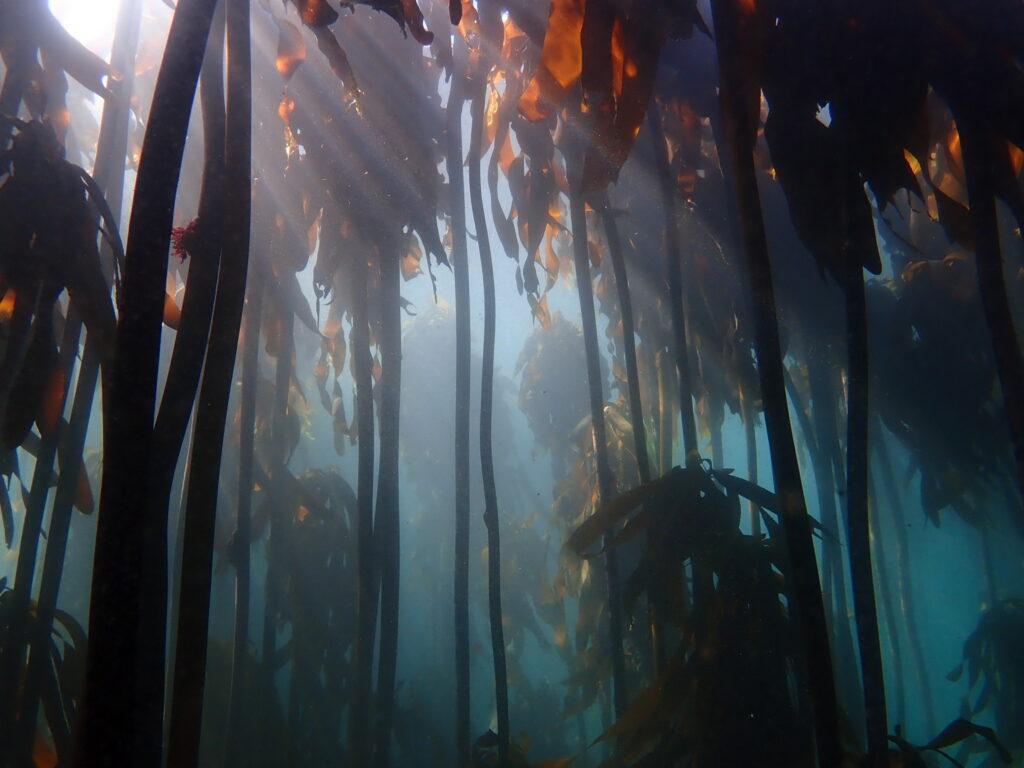
How does a kelp forest work?
Kelp might resemble an underwater tree, but biologically it is quite different. It belongs to a group of brown algae and has no true roots, stems or leaves. Instead, specialised structures allow it to attach to the seabed, withstand powerful water movement and capture sunlight for photosynthesis.
The holdfast: A home for marine life
At the base of each kelp is a holdfast, a branching structure that anchors the organism to rock. Unlike plant roots, holdfasts do not absorb nutrients from the substrate, as kelp takes up nutrients directly from the surrounding seawater.
The spaces between the holdfast’s branches also provide shelter for small marine animals. In a 2024 study, researchers examined 40 sea bamboo holdfasts from the South African coastline and identified 120 families of marine invertebrates belonging to nine major animal groups. This remarkable diversity exists within an area that snorkelers might easily overlook.
The stipe: Built to withstand moving water
The stipe connects the holdfast to the upper sections of the kelp. Sea bamboo has a hollow, gas-filled stipe and a buoyant structure near its upper end, helping to keep its fronds close to the surface where sunlight is readily available.
Flexibility is equally important. Rather than resisting waves and surge, the stipe bends with the movement of the water, reducing the forces acting on the kelp. Watching these large structures move with the ocean provides a fascinating demonstration of how marine organisms adapt to their environment.
The fronds: Capturing sunlight
The broad fronds absorb sunlight for photosynthesis, producing organic material that supports the surrounding food web. Some of this material is consumed by grazing animals, while detached kelp provides food for organisms elsewhere in the coastal ecosystem.
Together, the canopy, stipes and holdfasts create multiple layers of habitat. Fish shelter among the kelp, smaller invertebrates occupy its surfaces, and numerous other animals live on the rocky reef beneath it.
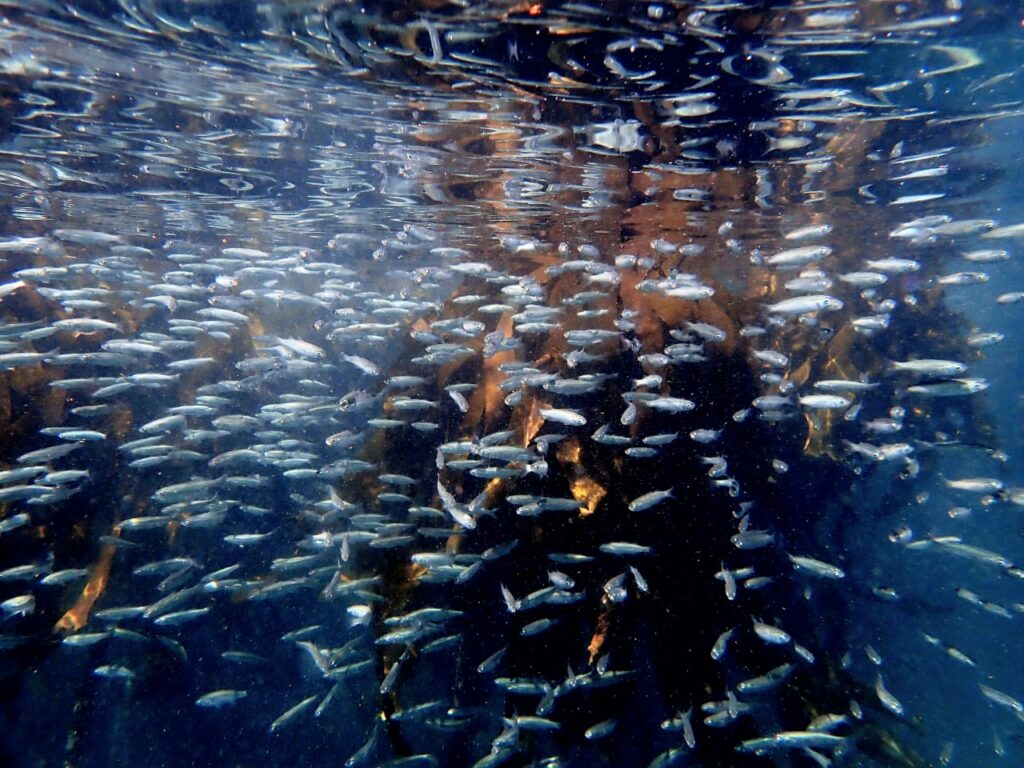
What marine life can you see in Cape Town's kelp forests?
One of the most interesting aspects of exploring these forests is the variety of animals that can be encountered within a relatively small area. Some are immediately recognisable, while others rely on camouflage or spend much of their time hiding among rocks and kelp.
Colourful reef inhabitants
Despite the cold water, Cape Town’s reefs contain an impressive variety of colours. Sea anemones attach themselves to rocks and use their tentacles to capture prey, while sea urchins graze on algae. Sea stars, brittle stars and sea cucumbers occupy different feeding roles on the seabed, contributing to the functioning of the reef ecosystem.
Nudibranchs are particularly interesting. These often brightly coloured marine molluscs feed on specialised prey, including sponges and other invertebrates. Sea fans, which resemble delicate underwater plants, are actually colonies of tiny coral animals that capture food particles from the water.
Among the local fish species is the Red Roman (Chrysoblephus laticeps), a striking red-orange fish associated with South Africa’s rocky reefs. Red Roman have an unusual reproductive strategy: they begin life as females, and some later develop into males. Larger males often establish territories, making them interesting subjects for observing reef fish behaviour.
Octopuses and cuttlefish
Octopuses are among the kelp forest’s most fascinating predators. They feed on crabs, molluscs and other marine animals, using their flexible bodies to investigate narrow spaces between rocks and shelter inside crevices.
Their camouflage abilities are remarkable. Specialised pigment cells allow octopuses to change colour rapidly, while muscular control of their skin enables them to imitate different textures. An octopus resting against a rock may be almost impossible to distinguish from its surroundings until it moves.
Cuttlefish, which are closely related to octopuses, also use rapid colour and pattern changes for communication and camouflage. Observing these animals without disturbing them offers an opportunity to appreciate their complex behaviour.
Shysharks and pyjama sharks
Cape Town’s kelp forests are home to several small shark species, including puffadder shysharks and pyjama sharks. Both are bottom-associated predators that feed on smaller marine animals such as crustaceans, fish and cephalopods.
The puffadder shyshark has a particularly interesting defensive behaviour. When threatened, it can curl its body into a tight circle and cover its eyes with its tail, explaining its common name.
Pyjama sharks are easily recognised by the dark stripes running along their bodies. Endemic to temperate South African waters, they are commonly associated with rocky reefs and kelp habitats. Neither species is normally considered dangerous to snorkelers, although they should never be touched, cornered or pursued.
Unexpected encounters
Some of the larger marine animals are encountered less frequently. Short-tail stingrays occasionally move across sandy areas bordering the reefs, while Cape fur seals may be observed swimming nearby.
African penguins are another possibility, particularly around the Simon’s Town coastline. Although they regularly enter the surrounding waters to feed, seeing one swim past during a snorkeling experience is unusual. Encounters with wild animals are unpredictable, which is part of what makes exploring natural marine habitats so interesting.
Why are kelp forests important?
Kelp forests play several important ecological roles, particularly by providing habitat for marine life. Their physical structure creates shelter, feeding opportunities and living space that would otherwise be absent from the rocky seabed. Certain fish and invertebrates also use these environments as nursery habitats, where young animals can find food and protection from predators.
These forests are highly productive ecosystems. Organic material generated through photosynthesis enters coastal food webs through grazing, decomposition and the movement of detached kelp. Dense kelp canopies can also reduce water movement within the forest, influencing conditions for the animals living beneath them.
Kelp absorbs carbon dioxide during photosynthesis, contributing to interest in its potential role in carbon storage. However, carbon absorption does not automatically mean permanent carbon sequestration. While some kelp-derived material may reach deeper waters or sediments, scientists are still investigating how much contributes to long-term carbon storage.
Beyond their ecological importance, kelp forests support fisheries, marine tourism and coastal communities. Protecting these habitats is essential for maintaining biodiversity and the wider health of South Africa’s marine environment.
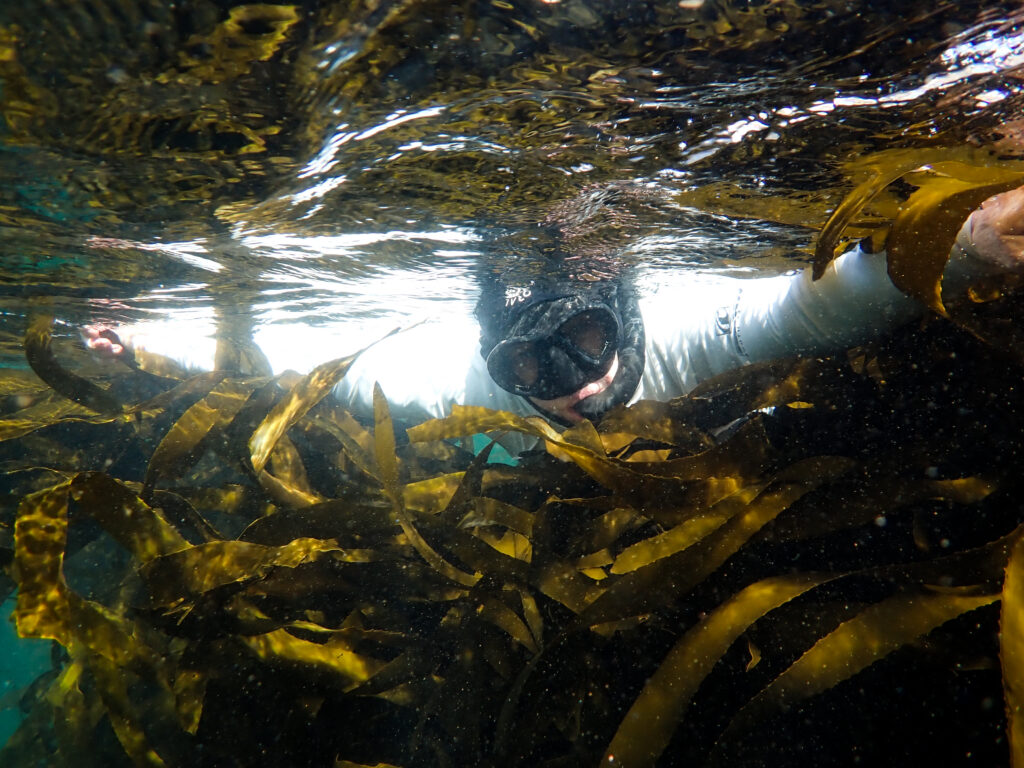
What is kelp forest snorkeling actually like?
Kelp forest snorkeling in Cape Town offers a straightforward way to explore this environment while remaining at the ocean’s surface. One of the first noticeable differences from tropical snorkeling is usually the temperature, particularly when upwelling brings colder water to the surface. A suitable wetsuit provides insulation and additional buoyancy, allowing snorkelers to float comfortably while observing the marine environment below.
From the surface, it is possible to look through the kelp canopy and follow the long stipes towards the rocky seabed. The forest’s appearance changes with the depth, sunlight and movement of the water. Some areas open into sandy gullies, while others contain dense stands of kelp where fish shelter among the fronds.
Moving slowly is often more productive than covering large distances. Many reef animals rely on camouflage or remain motionless when approached, making them easy to miss. An octopus might be hidden inside a crevice, a crab could be moving across the kelp, or a fish may be resting against a similarly coloured rock.
Importantly, you do not need to hold your breath and dive underwater to enjoy the kelp forest. Much of its biodiversity can be observed from the surface, particularly in shallower areas with good visibility. This makes snorkeling an accessible way to explore the ecosystem without the training or equipment required for scuba diving or freediving.
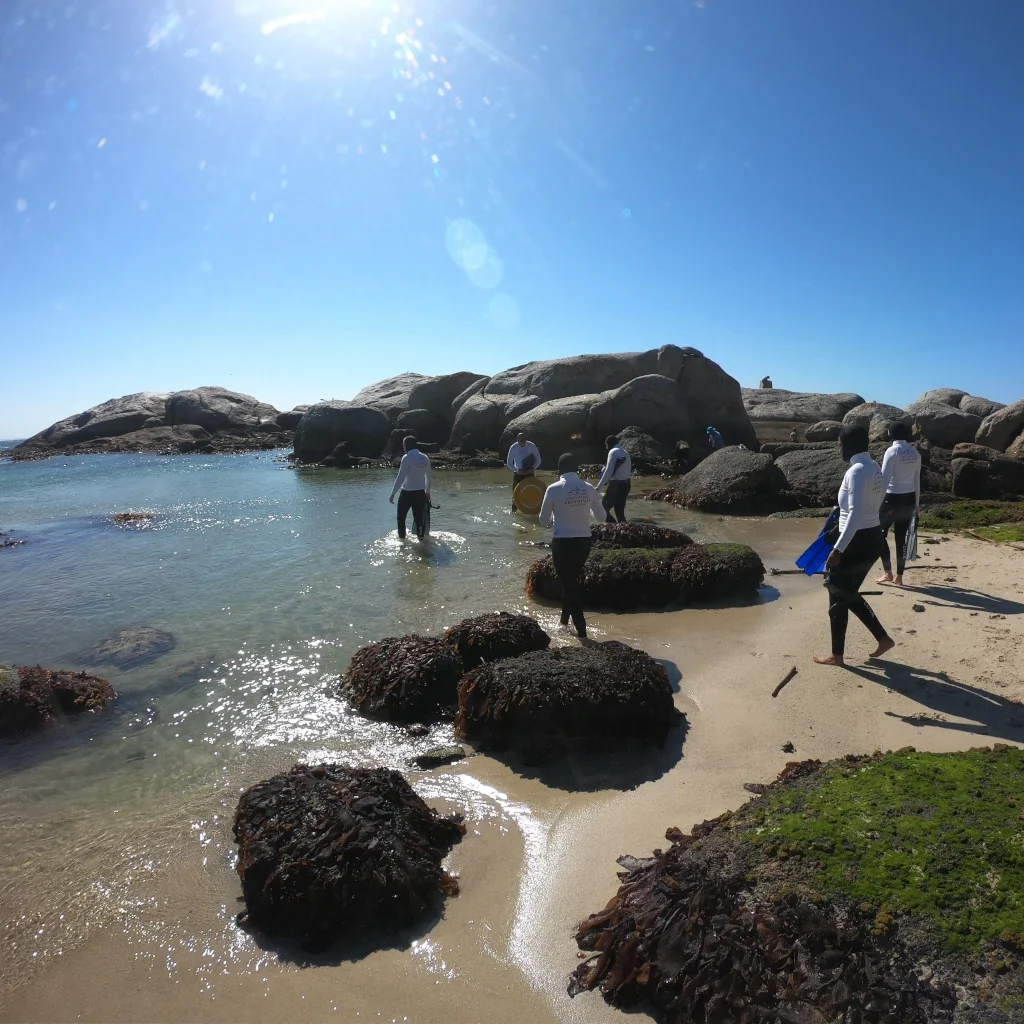
Where can you snorkel in Cape Town's kelp forests?
The Cape Peninsula offers a variety of kelp forest snorkeling locations, each with different underwater features and exposure to ocean conditions. Some sites have sheltered bays and shallow rocky reefs, while others are more exposed to swell and changing currents. Choosing an appropriate location depends largely on the conditions on the day.
Windmill Beach, Simon’s Town
Windmill Beach is one of Cape Town’s best-known locations for kelp forest snorkeling. Situated along the False Bay coastline near Boulders Beach, it features large granite boulders, sandy entry areas and rocky gullies surrounded by kelp.
The reef supports a variety of marine life, including small fish, sea stars, anemones, shysharks and numerous invertebrates. The arrangement of the granite boulders can provide shelter from certain ocean conditions, making the area particularly suitable for introductory snorkeling when the sea state is favourable.
Cosy Bay, Atlantic Seaboard
Cosy Bay offers a different environment along Cape Town’s Atlantic coastline. Kelp grows among granite boulders and rocky reef structures, with sandy areas separating sections of the reef.
The underwater terrain provides opportunities to observe both large kelp structures and smaller animals living among the rocks. Conditions are strongly influenced by swell and wind direction, so careful assessment is important before entering the water.
Other locations around the peninsula
Several other locations, including areas around Oudekraal and Clifton, provide access to kelp forest habitats. Each site has its own characteristics, and conditions can vary considerably between different sections of the coastline.
A site that offers comfortable snorkeling one day may be unsuitable the next because of increased swell, changing winds or reduced visibility. Local knowledge is particularly valuable when deciding where to explore.
When is the best time to go snorkeling?
Kelp forest snorkeling in Cape Town is possible throughout the year, although conditions vary considerably between locations and seasons. Unlike destinations where underwater visibility follows a predictable seasonal pattern, the Cape Peninsula is influenced by changing wind systems, ocean swell and coastal upwelling.
During summer, strong southeasterly winds frequently affect the region. Along the Atlantic coastline, these winds can trigger upwelling, bringing cold, nutrient-rich water towards the surface. The resulting water can be exceptionally clear, although temperatures may be considerably lower than visitors expect during Cape Town’s warmest months.
Winter brings more frequent northwesterly winds and cold fronts, sometimes making exposed Atlantic locations unsuitable. However, parts of the western False Bay coastline may offer favourable conditions during suitable weather windows.
Recent swell, wind direction and the time since the last storm all influence visibility and comfort. Upwelling can also be followed by plankton growth, temporarily reducing water clarity. The best day for snorkeling is not necessarily the warmest or sunniest day; calm water, manageable surge and good visibility are generally more important.
What equipment do you need?
Snorkeling in Cape Town requires slightly different equipment from tropical destinations, primarily because of the cooler water temperatures. Proper thermal protection is essential for comfort and helps reduce heat loss during a session.
A 5 mm wetsuit is commonly used for guided snorkeling experiences around Cape Town, although water conditions and individual cold tolerance vary. Wetsuits also provide buoyancy, helping snorkelers remain at the surface with less effort. Neoprene gloves or socks may provide additional comfort in colder conditions.
A well-fitting mask provides a clear underwater view, while a snorkel allows you to breathe while floating face-down at the surface. Fins improve swimming efficiency and reduce the effort required to move through the water. Short recreational fins are suitable for many snorkeling activities.
Safety is equally important. Participants should be able to swim unaided, understand the entry and exit points, and remain within their personal abilities. Snorkeling with a buddy, avoiding unnecessary breath-holding and choosing suitable conditions are fundamental precautions.
Although kelp forests can appear sheltered, waves, surge and currents may still be present. Exploring with an experienced local guide can be particularly beneficial for beginners who are unfamiliar with Cape Town’s coastal conditions.
How can you explore a kelp forest responsibly?
Marine animals generally behave more naturally when they are not disturbed. Approaching wildlife slowly and maintaining a respectful distance reduces unnecessary stress while often providing better opportunities to observe feeding, hunting and other natural behaviours.
Care should also be taken around the reef. Sea fans, anemones and other attached organisms can be damaged by careless fin movements or contact, while pulling on kelp may harm the habitats associated with it. Animals should never be chased, fed or handled, and shells and living organisms should be left where they are.
Parts of the Cape Peninsula fall within the Table Mountain National Park Marine Protected Area, including restricted zones where fishing and the removal of marine organisms are prohibited. These protected areas contribute to biodiversity conservation and provide important refuges for marine species.
Responsible snorkeling is straightforward: observe carefully, avoid unnecessary contact with the environment and leave marine life undisturbed.
Frequently asked questions
Is kelp forest snorkeling suitable for beginners?
Yes, provided participants can swim unaided and are comfortable entering the ocean. Choosing sheltered locations, using appropriate equipment and exploring with an experienced guide can make the activity more accessible. Previous snorkeling experience is helpful but not always necessary.
Is the water too cold for snorkeling?
Cape Town’s coastal waters can be very cold, particularly during upwelling events. However, a properly fitted wetsuit provides insulation, allowing many people to enjoy the experience comfortably. The time spent in the water should always take individual cold tolerance and conditions into account.
Do I need to dive underwater to see marine life?
No. Snorkeling is primarily a surface-based activity, and much of the kelp forest can be observed without diving underwater. Reef fish, sea stars, kelp structures and numerous other organisms may be visible from above, particularly in shallow areas with good visibility.
Are the sharks in Cape Town’s kelp forests dangerous?
Small species such as puffadder shysharks and pyjama sharks are not normally considered dangerous to swimmers. They generally avoid confrontation and are more likely to remain hidden or move away when approached. However, other shark species occur in Cape Town’s waters, so local safety guidance remains important.
Can children go kelp forest snorkeling?
Children who can swim confidently may enjoy snorkeling in suitable conditions with appropriately fitted equipment and close adult supervision. Cape Town Freediving accepts children older than six, subject to swimming and health requirements, with a parent or guardian accompanying them in the water.
Experience the Great African Seaforest with Cape Town Freediving
Learning about the Great African Seaforest provides an introduction to its ecology, but observing these animals in their natural habitat offers a different perspective. Snorkeling allows you to see how kelp, rocky reefs and their inhabitants interact while discovering marine species that are often overlooked from the shore.
At Cape Town Freediving, we offer guided snorkeling experiences designed to introduce visitors and locals to the remarkable biodiversity of Cape Town’s kelp forests. Our experienced guides help identify marine animals, explain their behaviour and share insights into the ecology of this distinctive underwater environment. The emphasis is on exploration, observation and developing a better understanding of the marine life encountered along the way.
We provide all necessary snorkeling equipment and select our shore-entry locations according to ocean conditions. No previous snorkeling experience is required, although participants must be able to swim unaided. With approximately 60 to 90 minutes spent exploring the water, there is time to discover the reef, observe its inhabitants and enjoy the experience at a comfortable pace.
Whether you’re visiting Cape Town or have lived here for years, snorkeling offers an opportunity to discover a side of the coastline that is often overlooked.
Explore our guided kelp forest snorkeling experiences and book your adventure.


